Afghan Youth Coalition Platform
Building a modern digital advocacy ecosystem for Afghan youth through research, structured participation, and scalable community engagement.
The Challenge
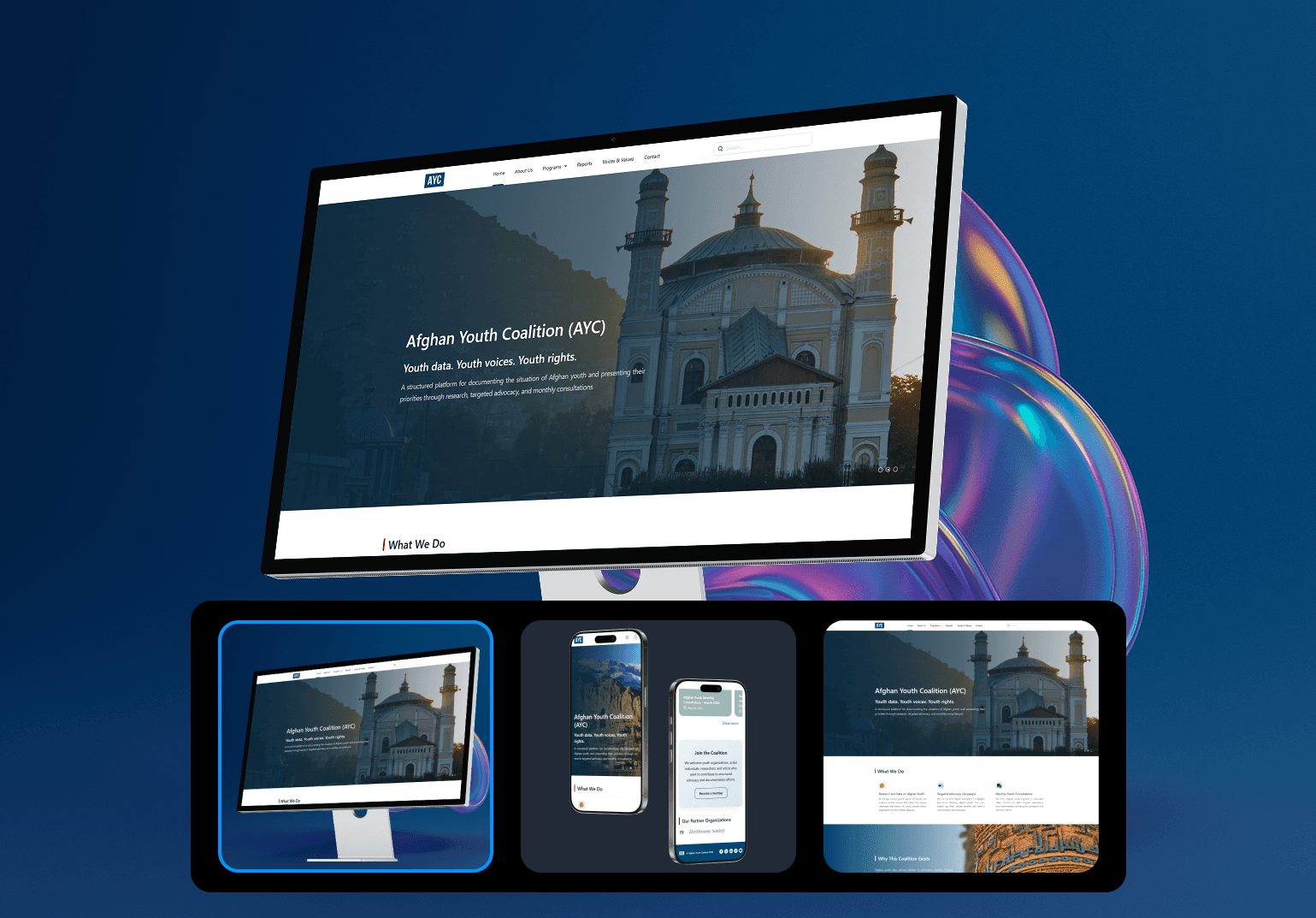
The Afghan Youth Coalition platform was designed as a mission-driven digital ecosystem focused on amplifying Afghan youth voices through research, structured advocacy, and community collaboration. The platform acts as both a public-facing awareness website and a foundational infrastructure for youth participation, consultations, digital campaigns, and long-term documentation initiatives. The product positioning strategically balances credibility, accessibility, and emotional storytelling. Instead of functioning as a traditional NGO brochure website, the platform operates more like a lightweight civic engagement system that combines publication workflows, advocacy storytelling, consultation management, and coalition-building into a unified digital experience. The platform architecture appears intentionally lightweight and highly maintainable, prioritizing accessibility in low-bandwidth regions while still delivering a modern, polished interface. The information hierarchy strongly emphasizes clarity, trust, and participation, ensuring that youth organizations, activists, researchers, and international partners can quickly understand the coalition’s mission and engage with its initiatives. The product ecosystem likely includes a headless or CMS-driven publishing workflow, administrative moderation systems, campaign management tools, consultation intake systems, and scalable content operations that support multilingual growth and future expansion into broader regional youth initiatives.
Page Speed
0.6s
LCP
0.8s
Grade
A
Score
96%
Objectives
- Establish a credible and trustworthy digital identity for Afghan Youth Coalition as a structured advocacy and research-focused organization.
- Create a centralized platform for documenting youth challenges, consultation outcomes, and research findings across Afghanistan and the Afghan diaspora.
- Design an accessible platform optimized for users with limited internet bandwidth and older mobile devices commonly used across the region.
- Increase youth participation through simplified engagement funnels including coalition membership, consultation participation, and campaign contribution.
- Provide a scalable publishing infrastructure capable of supporting reports, articles, consultations, campaigns, announcements, and future policy documentation.
- Build a professional online presence that increases legitimacy with international organizations, NGOs, policy institutions, and research partners.
- Create a digital storytelling system capable of combining quantitative research data with human-centered narratives and advocacy visuals.
- Develop a responsive experience that maintains usability consistency across desktop, tablet, and mobile environments.
- Improve discoverability through search engine optimization and structured content architecture.
- Establish a maintainable technical foundation that allows non-technical administrators to publish and manage content independently.
- Enable future integrations with survey systems, analytics dashboards, multilingual content systems, and donor engagement platforms.
- Strengthen youth representation by providing a structured channel for participation, feedback collection, and organized digital advocacy.
The Scope
- Discovery workshops and organizational positioning analysis.
- Youth-focused UX research and accessibility evaluation.
- Content strategy development for advocacy and research publication.
- Information architecture planning for scalable organizational growth.
- Responsive UI/UX design system development.
- Homepage strategy focused on mission clarity and conversion optimization.
- Research and publication section structuring.
- News and updates module implementation.
- Coalition membership onboarding flow design.
- Partner organization showcase system.
- Campaign-focused content presentation structure.
- Administrative publishing workflow planning.
- SEO metadata architecture implementation.
- Performance-first frontend engineering.
- Accessibility-focused typography and contrast optimization.
- Mobile-first responsive development.
- Scalable reusable component library creation.
- Structured navigation and CTA optimization.
- Cloud hosting and CDN architecture planning.
- Analytics and engagement tracking infrastructure.
- Security hardening and form validation implementation.
- Future-ready multilingual architecture planning.
- Structured image optimization pipeline.
- Consultation and event-oriented content system design.
- Publication-ready CMS integration architecture.
Our Process
- Conducted a full organizational and stakeholder analysis to understand the coalition’s advocacy mission, target audiences, and long-term operational goals.
- Mapped key user personas including Afghan youth participants, researchers, NGOs, advocacy partners, journalists, diaspora communities, and international organizations.
- Performed content audits to structure information around advocacy priorities, research documentation, and coalition participation.
- Designed a simplified information hierarchy prioritizing clarity, trust, and engagement accessibility.
- Created a minimal but emotionally impactful visual language aligned with humanitarian and civic engagement platforms.
- Developed responsive wireframes optimized for mobile-first browsing behavior common in low-connectivity environments.
- Built reusable UI sections for campaigns, reports, updates, and consultation-driven content publishing.
- Implemented modular layouts allowing administrators to continuously expand the platform without redesigning the system.
- Designed strategic CTA placements to increase coalition membership and engagement conversion rates.
- Optimized typography scales and spacing systems for multilingual readability and accessibility.
- Focused on lightweight frontend delivery to improve loading performance on slower internet connections.
- Implemented scalable content structures supporting future publication categories and dynamic archives.
- Designed partner showcase modules to improve institutional trust and coalition legitimacy.
- Integrated SEO-friendly semantic structures to improve discoverability for advocacy-related search traffic.
- Created scalable design tokens and component systems to ensure visual consistency across future platform growth.
Key Solutions
- Implemented a clean and minimal interface system focused on typography clarity, whitespace balance, and structured storytelling.
- Adopted a lightweight frontend architecture optimized for performance and low-bandwidth accessibility.
- Designed modular content sections enabling rapid publication of campaigns, consultations, and research reports.
- Created strong visual hierarchy systems to guide users through advocacy narratives and participation opportunities.
- Introduced responsive layouts optimized specifically for mobile-first consumption patterns.
- Structured the homepage around mission clarity, social proof, and action-oriented engagement.
- Implemented reusable card-based content systems for scalability and content consistency.
- Designed accessible CTA systems encouraging membership applications and coalition participation.
- Integrated SEO-focused semantic structures and metadata strategies for improved visibility.
- Optimized image delivery and media rendering to reduce performance bottlenecks.
- Planned role-based CMS publishing workflows for administrators, editors, and campaign managers.
- Established scalable infrastructure assumptions using CDN-backed static delivery and cloud hosting architecture.
- Designed future-ready integration pathways for surveys, analytics, newsletters, and consultation management systems.
- Applied accessibility best practices including readable contrast ratios, scalable typography, keyboard-friendly navigation, and semantic content structures.
- Created a flexible design system enabling future feature expansion without disrupting brand consistency.
- Structured the ecosystem to support future donor systems, multilingual content support, and analytics dashboards.